
Restaurant graphic design is more than creating a logo or making a menu look attractive. Every visual customers see can influence how they perceive your restaurant, from the first social media post they discover to the menu they read, the sign they see outside, and the packaging they take home.
A strong restaurant design system makes your business easier to recognize, easier to understand, and more consistent across customer touch points. It can also make your marketing easier to manage because your team has a clear visual direction for promotions, social media, menus, advertising, and other materials.
This restaurant graphic design checklist shows you what to prioritize, what to review, and how to create a consistent visual identity across your restaurant. For a deeper look at how graphic design shapes your restaurant's brand identity and customer experience, explore our Ultimate Guide to Restaurant Graphic Design.
Restaurant Graphic Design Checklist: The Quick Answer
The most important graphic design elements for a restaurant are:
- Brand identity and logo
- Color palette and typography
- Restaurant menu design
- Food photography and image treatment
- Website and online ordering visuals
- Social media graphics
- Restaurant signage
- Promotional and advertising materials
- Takeout and delivery packaging
- In restaurant promotional materials
- Email and loyalty marketing graphics
- Brand guidelines and reusable design templates
The priority should not be to design everything at once. Start with the visual elements customers interact with most often, establish a consistent brand system, and then expand that system across your marketing channels.
The priority should not be to design everything at once. Start with the visual elements customers interact with most often, establish a consistent brand system, and then expand that system across your marketing channels.
What Is Restaurant Graphic Design?
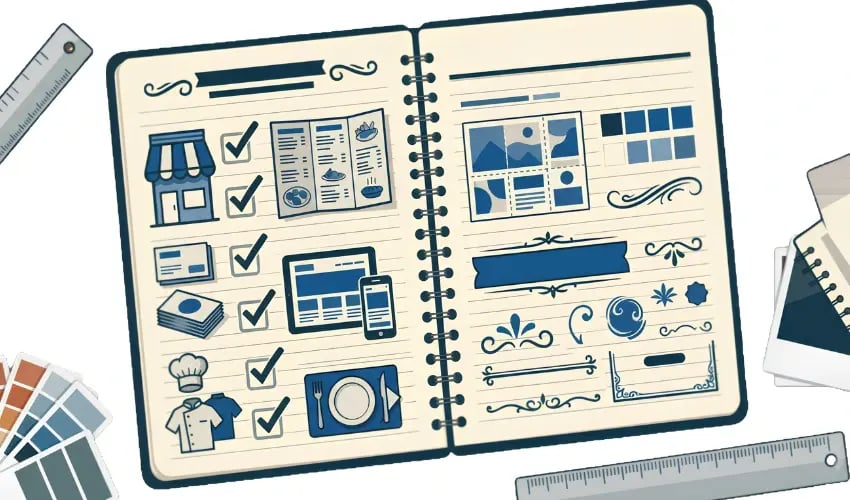
Restaurant graphic design is the visual communication used to represent a restaurant and its products across physical and digital customer touch points.
It can include the restaurant's logo, menus, website graphics, food photography, signs, packaging, social media posts, advertisements, flyers, email graphics, loyalty promotions, table materials, and event designs.
The goal is not simply to make those materials look attractive.
Effective restaurant graphic design should help customers understand:
- Who the restaurant is
- What type of experience they can expect
- What products or dishes are being promoted
- What action they should take
- Why the restaurant is different from competing options
A casual burger restaurant, an upscale dining establishment, a Korean BBQ restaurant, and a family buffet should not necessarily look the same. Their design should communicate the experience each business wants to create.
Why Does Restaurant Graphic Design Matter?
Customers can encounter your restaurant many times before making a purchase.
They might see your Instagram post, Google Business Profile photos, website, menu, storefront sign, online ordering page, advertisement, or takeout packaging before they ever visit.
When those visual experiences feel disconnected, the restaurant can appear less established than it actually is.
When the visual identity is consistent, customers can more easily recognize the business across different channels.
The important distinction is that good design is functional as well as visual.
A beautiful menu that is difficult to read is not effective. A striking advertisement that does not communicate the offer is not effective. A great social media graphic that hides the restaurant name or call to action is not effective.
Restaurant design should always connect appearance with purpose.
The Complete Restaurant Graphic Design Checklist
1. Create a Clear Restaurant Brand Identity
Before creating individual graphics, establish the visual foundation of your restaurant.
Your brand identity should define the basic visual elements that will appear repeatedly across your marketing.
Your restaurant branding checklist
-
Logo
-
Secondary logo or simplified logo
-
Brand colors
-
Primary and secondary fonts
-
Typography rules
-
Image style
-
Graphic elements or patterns
-
Icon style
-
Brand voice and messaging direction
-
Examples of correct and incorrect usage
Your design choices should reflect the restaurant you actually operate.
For example, a fast casual restaurant may benefit from bold typography, energetic graphics, and high contrast. A fine dining restaurant may need a more restrained visual approach. A family restaurant may use a friendlier and more approachable design system.
The goal is not to follow a particular design trend. The goal is to make the visual identity fit the restaurant.
Create a brand style guide
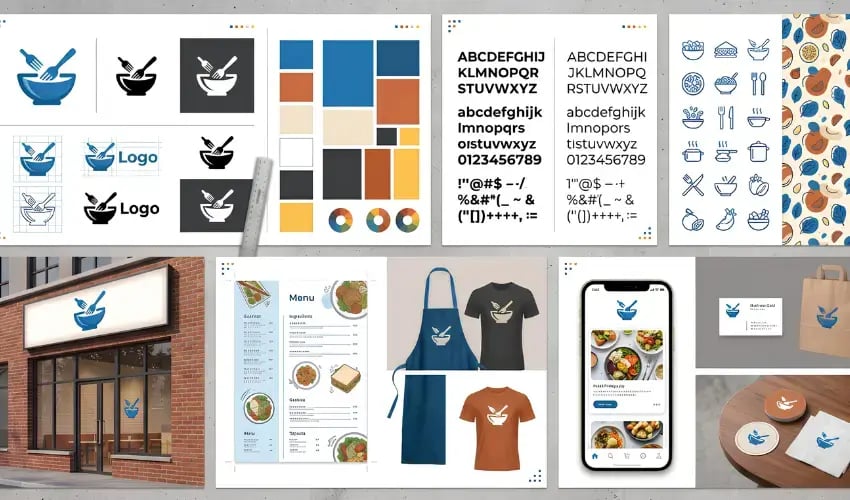
A simple brand guide can save your team significant time.
Instead of deciding from scratch which font, color, logo version, or design style to use every time a promotion is created, your team can work from an established system.
For restaurants with multiple locations, this becomes even more important because it helps maintain consistency while still allowing location specific promotions.
2. Review Your Restaurant Logo
Your logo is one of the most recognizable elements of your visual identity, but it should not be expected to do everything.
A strong restaurant logo should be:
- Easy to recognize
- Legible at small sizes
- Appropriate for the restaurant concept
- Reusable across print and digital materials
- Flexible enough for signage, menus, packaging, and social media
- Available in appropriate file formats
Restaurant logo checklist
-
Full color logo
-
Single color version
-
Horizontal version if needed
-
High resolution files
-
Social media profile version
-
Consistent spacing around the logo
Avoid constantly changing the appearance of your logo from one promotion to another.
A restaurant does not need a new logo every time it launches a campaign. Instead, build recognizable campaign graphics around the existing brand.
3. Build a Consistent Color and Typography System
Colors and fonts influence how your restaurant looks across every channel.
The problem many restaurants face is not choosing the wrong colors or fonts. It is using too many of them.
A practical restaurant design system can start with:
- One primary brand color
- One or two supporting colors
- One primary display font
- One easy to read supporting font
- A consistent approach to headings and body text
The system should work on menus, social media graphics, signs, advertisements, email campaigns, and websites.
Check for consistency
Open five recent marketing materials side by side.
Do they look like they came from the same restaurant?
If the answer is no, the problem may not be individual designs. The problem may be the absence of a clear brand system.
4. Design Your Menu Around the Customer Experience
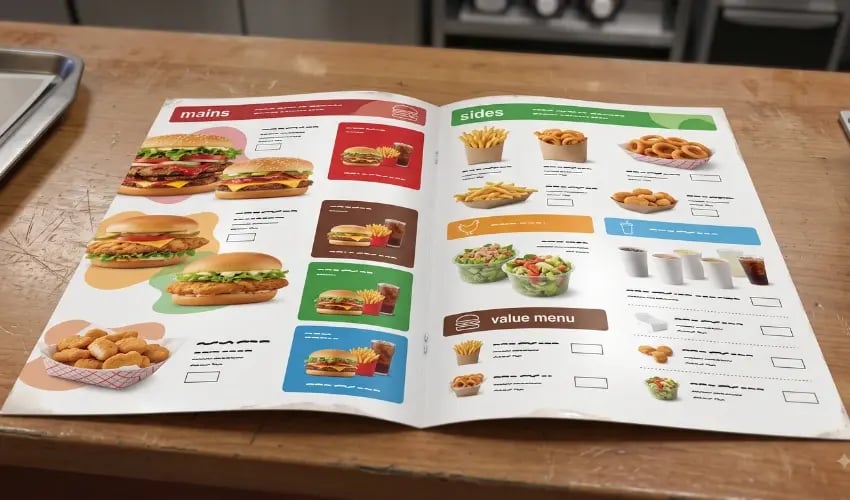
Your menu is one of the most important pieces of restaurant design because it combines branding, information, pricing, and purchasing decisions in one place.
A menu should make it easy for customers to answer:
-
What do they serve?
-
What sounds good to me?
-
How much does it cost?
-
What should I choose?
Restaurant menu design checklist
-
Clear category structure
-
Easy to read typography
-
Consistent item descriptions
-
Clear pricing
-
Logical spacing
-
Strong visual hierarchy
-
Clear differentiation between categories
-
High quality food photography where appropriate
-
Visible featured items
-
Accurate information
-
Print and digital versions checked separately
-
Mobile readability tested for digital menus
Use design to support menu decisions
Menu design should not be treated as decoration alone.
Restaurant operators can use sales and profitability information to identify items that deserve more attention. Menu engineering combines item popularity and profitability with menu presentation to help restaurants decide which items to feature and which may need review.
For example, a restaurant might use a visual treatment to bring attention to a signature item, popular combination, or strategically important dish.
The design should support the restaurant's business goals without making the menu confusing or difficult to navigate.
Design printed and digital menus separately
A printed menu and a mobile menu may contain the same information, but they are not the same design problem.
A printed menu can use a larger physical layout.
A phone screen requires customers to scroll, tap, and zoom within a much smaller space.
Always test the digital menu on an actual mobile device before publishing it.
5. Create a Strong Food Photography Style
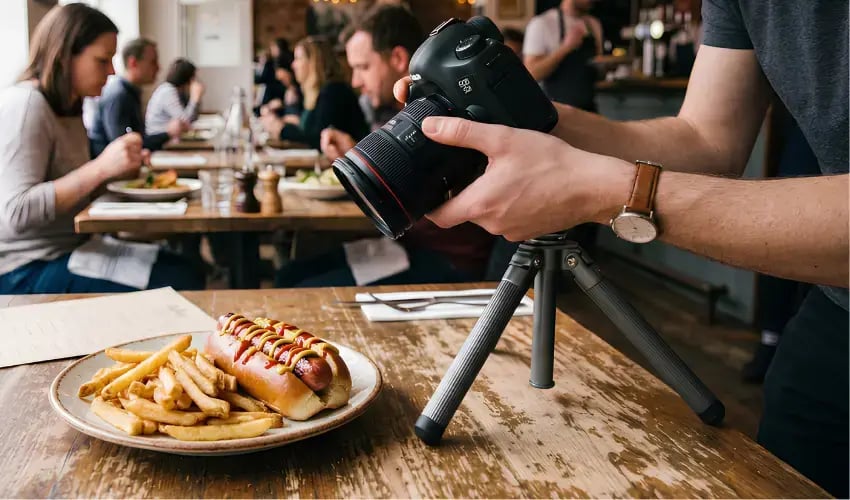
Restaurant graphic design depends heavily on photography.
A strong dish can lose its appeal when the image is poorly lit, badly cropped, low resolution, or surrounded by distracting graphics.
Your restaurant should establish a consistent photography direction.
Food photography checklist:
-
Consistent lighting
-
Appropriate background treatment
-
Accurate food colors
-
Clear focus point
-
High resolution images
-
Minimal unnecessary distractions
-
Images that represent actual menu items
Do not use design to misrepresent the food.
The purpose of editing should be to present the actual product clearly and attractively, not to create a dish that customers will not recognize when it arrives.
Think beyond the menu
Food photography can also support:
-
Social media
-
Website banners
-
Online ordering
-
Digital advertising
-
Email campaigns
-
Promotional flyers
-
Seasonal campaigns
-
Loyalty marketing
A well organized restaurant photo library can make future marketing much easier.
6. Design Your Website for Restaurant Customers
Your restaurant website is often a customer's first digital interaction with your brand.
The design should prioritize information customers actually need.
At minimum, make it easy to find:
-
Menu
-
Location
-
Hours
-
Contact information
-
Ordering options
-
Reservation information where applicable
-
Important promotions
-
Directions
Restaurant website design checklist:
-
Mobile friendly design
-
Clear navigation
-
Strong restaurant branding
-
Readable menu
-
High quality food imagery
-
Clear calls to action
-
Consistent fonts and colors
-
Easy to find location and hours
-
Fast access to ordering or reservations
-
Consistent visual experience with social media
A website should not force customers to hunt for basic information.
Good website design reduces friction.
7. Build a Social Media Design System
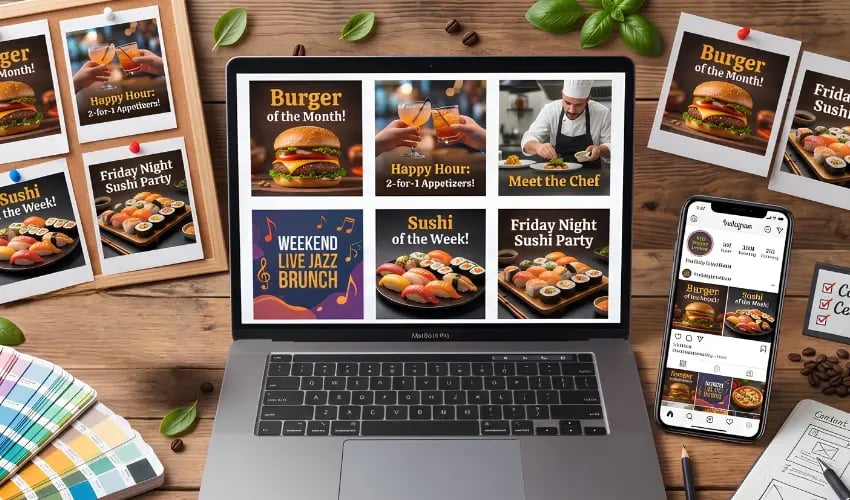
Restaurants frequently create social media graphics one post at a time.
That can lead to inconsistent fonts, colors, layouts, and messaging.
A better approach is to create reusable templates.
Restaurant social media design checklist
Create templates for:
-
Promotions
-
New menu items
-
Events and Holidays
-
Customer reviews
-
Restaurant announcements
-
Promotions
Templates do not mean every post has to look identical.
Instead, they provide a recognizable framework that allows the content to change while the brand remains consistent.
Design for mobile viewing
Social graphics are usually viewed on relatively small screens.
Important information such as the offer, date, restaurant name, and call to action should be easy to understand without requiring the viewer to zoom in.
8. Improve Restaurant Signage
Restaurant signage has a very different job from a social media graphic.
A customer may have only a few seconds to see a sign from a road or parking lot.
That means clarity matters more than complexity.
Signage checklist
-
Restaurant name is easy to read
-
Logo is visible
-
Contrast is sufficient
-
Important information is prioritized
-
Lettering is readable from an appropriate distance
-
Colors match the brand
-
Sign design works in daylight and relevant nighttime conditions
-
Directional signs are easy to understand
-
Window graphics are not overcrowded
-
Promotional signs do not compete with the primary storefront identity
Think about signage as part of your customer's navigation experience, not simply as decoration.
9. Design Your Takeout and Delivery Packaging
Packaging is another opportunity to extend your brand after the customer leaves the restaurant.
You do not necessarily need completely custom packaging for everything.
Small branded elements can also make a difference.
Consider:
-
Logo stickers
-
Branded bags
-
Box labels
-
Printed inserts
-
Loyalty messages
-
Review requests
-
Promotional cards
-
Reorder information
Packaging checklist
-
Logo is clearly visible
-
Brand colors are consistent
-
Important information remains readable
-
Materials suit the food being served
-
Promotional messaging is easy to understand
-
Packaging does not interfere with food presentation or function
The best packaging design balances branding with practicality.
10. Create Promotional and Advertising Templates
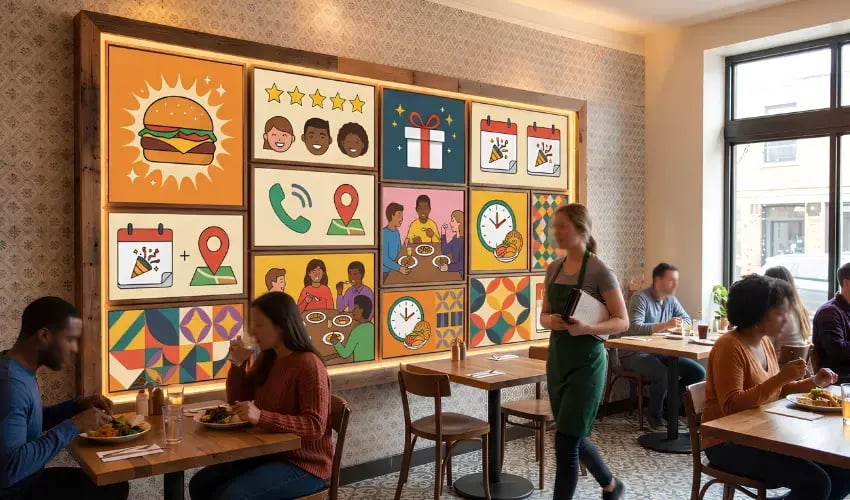
Restaurants constantly need promotional graphics.
Creating every campaign from scratch can be slow and can result in inconsistent branding.
Develop templates for recurring promotional needs.
Promotional design checklist
-
Limited time offers
-
New menu launches
-
Grand opening campaigns
-
Location openings
-
Events
-
Holiday promotions
-
Loyalty offers
-
Discount campaigns
-
Seasonal campaigns
-
Paid advertising graphics
-
Printable promotional materials
Every promotional graphic should answer three questions quickly:
What is being offered?
Why should I care?
What should I do next?
The call to action might be to visit the restaurant, place an order, make a reservation, download an app, claim an offer, or visit a specific location.
11. Design In Restaurant Materials
Your brand should not disappear once a customer walks through the front door.
Depending on the restaurant, design may be needed for:
-
Table tents
-
Counter signs
-
Menu boards
-
Wall graphics
-
Promotional cards
-
Loyalty program materials
-
QR code signs
-
Event materials
-
Restroom signs
-
Directional signs
-
Promotional displays
Important rule
Do not turn every surface into an advertisement.
Customers should still be able to move through the restaurant comfortably and understand important information without visual clutter.
Use design to improve the experience, not overwhelm it.
12. Create Email and Loyalty Marketing Graphics
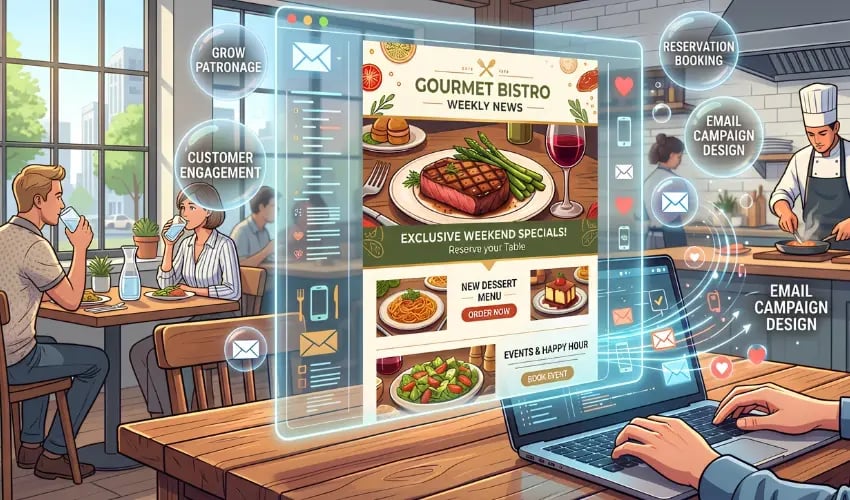
Email campaigns are another place where consistency matters.
A restaurant may use email to promote:
-
New menu items
-
Special offers
-
Events
-
Birthday promotions
-
Location announcements
-
Customer appreciation campaigns
Email design checklist
-
Restaurant branding is immediately recognizable
-
Main offer is easy to identify
-
Important text is readable on mobile
-
Images support the message
-
Call to action is obvious
-
Links and buttons are easy to tap
-
Footer information is consistent
-
Email design matches the website and social media
A good email graphic should support the message rather than making the message harder to find.
Frequently Asked Questions About Restaurant Graphic Design
What is included in restaurant graphic design?
Restaurant graphic design can include logos, branding, menus, website graphics, social media posts, signage, packaging, promotional materials, advertising graphics, email designs, event materials, and other visual assets used to communicate with customers.
What graphic design does a new restaurant need first?
A new restaurant should generally establish its brand identity first, including its logo, colors, typography, photography direction, and basic visual guidelines. The identity can then be applied to the menu, website, signage, social media, packaging, and promotional materials.
How does graphic design help a restaurant?
Effective graphic design helps a restaurant communicate its brand, present information clearly, create a consistent customer experience, promote products and offers, and become easier for customers to recognize across different channels.
What should a restaurant menu design include?
A restaurant menu should include clear categories, readable item names and descriptions, accurate pricing, logical organization, and a visual hierarchy that helps customers navigate their choices. Menu design can also support strategic item placement based on restaurant sales and profitability information.
Should restaurant branding be the same on every platform?
The core brand identity should remain consistent, but the execution can be adapted to the platform. For example, an Instagram post, printed menu, storefront sign, and email campaign may use different layouts while still sharing the same colors, typography, logo treatment, and overall visual style.
How often should a restaurant redesign its menu?
A menu should be reviewed whenever prices, offerings, branding, customer behavior, or business priorities change. Regular menu reviews are more useful than automatically redesigning the menu on a fixed schedule.
Is food photography part of restaurant graphic design?
Yes. Food photography is an important visual asset used in menus, websites, social media, advertising, online ordering, email marketing, and other restaurant marketing materials.
How can restaurants keep designs consistent across multiple locations?
Create a central brand guide that defines the approved logo, colors, fonts, imagery, layouts, and design rules. Then create location specific templates that allow each restaurant to customize information such as address, hours, and local promotions without changing the core brand identity.
What should be included in a restaurant design checklist?
A complete checklist should cover branding, logo usage, typography, colors, menus, photography, website design, social media templates, signage, packaging, promotional materials, email graphics, quality control, and brand guidelines.
Can restaurant graphic design improve marketing performance?
Good design can make marketing communication clearer and help customers notice, understand, and remember a promotion or brand. However, design should work alongside strong messaging, targeting, offers, customer experience, and other marketing activities rather than being treated as a standalone solution.
Final Takeaway: Design for Recognition, Clarity, and Action
Restaurant graphic design should do more than make your business look good.
The strongest restaurant design systems make the brand recognizable, information easy to understand, promotions easier to notice, and customer interactions more consistent.
Start with the foundation: your brand identity, logo, colors, typography, and photography style. Then apply that system to the touchpoints customers use most, including menus, websites, social media, signage, packaging, advertising, and loyalty marketing.
A restaurant does not need the most complicated design.
It needs a visual identity that customers can recognize, understand, and remember.